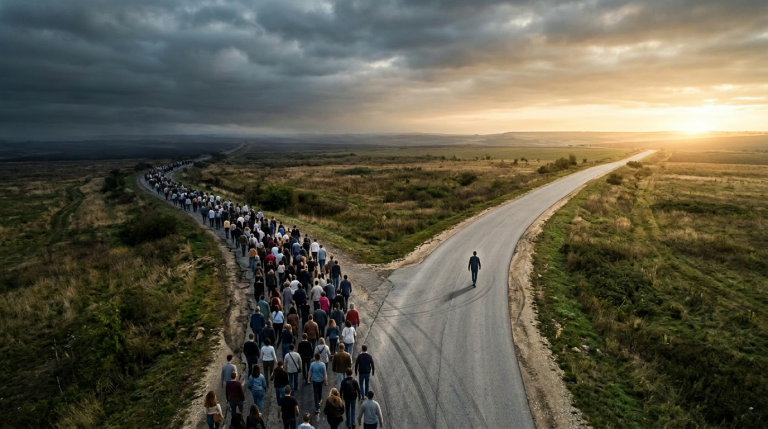
This post was first published in 2023. The thesis has not changed — the era of apathy is over, and the infrastructure to act on that is real. What has changed is the pace. The infrastructure is not arriving. It is moving — constantly, rapidly, in ways that reward the people who step into it while it is moving and leave behind the people who wait for it to stabilize. What follows is the updated argument.
The digital world has long been controlled by a few powerful entities. That sentence has been true for long enough that most people have stopped hearing it as a problem and started hearing it as a description of how things are.
That is what apathy looks like at scale. Not indifference — acceptance. The quiet assumption that the terms were set before you arrived and the best available move is to optimize within them. To build an audience on someone else’s platform. To store value in someone else’s system. To participate in an economy on terms you did not negotiate and cannot change.
The era of apathy is over. Not because the powerful entities have become less powerful — they haven’t. But because the technology now exists to build outside of them, on your own terms, with ownership intact from the beginning. The question is no longer whether that technology exists. The question is whether you are going to step into it before the window closes.
The Environment Is Not Stable — That Is the Point
The instinct is to wait. To let the technology mature, the regulations clarify, the winners emerge. To step in once it is safe.
That instinct will cost you the opportunity.
We are not in an era of arriving infrastructure. We are in an era of rapid, continuous evolution — where the tools available today are materially different from the tools available eighteen months ago, and the tools available eighteen months from now will be materially different again. AI is restructuring how intelligence moves. Blockchain is restructuring how value moves. The financial architecture of the global economy is shifting in real time — institutional players moving into digital asset infrastructure at a scale and speed that is rewriting the terms of access to capital.
The institutions that built the last economy are not watching this shift from the outside. They are inside it, moving fast, applying familiar frameworks to unfamiliar territory, and producing more of what already exists — scaled, optimized, and designed for the people the last economy was designed for.
The window for individuals and founders to build inside this shift — rather than react to it after the terms are set — is open. It is moving with the technology. It will not wait.
The Ownership Problem Was Always Structural
The digital economy was built on a specific bargain: access in exchange for data. Use the platform for free; the platform uses you for revenue. The terms were rarely stated explicitly. They didn’t need to be. Building your own infrastructure, hosting your own data, maintaining your own audience — these were technically and financially out of reach for most individuals and small organizations.
So people accepted the bargain. Not because it was fair. Because it was the only one available.
What that bargain produced, over time, was a digital economy in which the value created by individuals — their attention, their data, their content, their relationships — flows almost entirely to the institutions that own the infrastructure those individuals built on. The creator with a million followers owns nothing if the platform changes its algorithm. The founder whose company depends on a third-party marketplace owns nothing if the marketplace changes its terms.
Here is the part that rarely gets named directly: the institutions still control access to audiences, and most people — despite knowing this, despite distrusting the institutions — trust them more than they trust each other. That is the real obstacle. It is not technical. It is human. Building new infrastructure is possible. Building the trust required to operate that infrastructure collectively — to build audiences, collectives, and communities outside institutional control — is the hard part. That is where innovation and risk are actually required. That is where big ideas do their most important work.
Agency in the digital economy is not just a mindset, and it is not just infrastructure. It is both, simultaneously, and you cannot have one without the other. You cannot build new infrastructure and operate it with an old mindset. And you cannot sustain an agency mindset without infrastructure that makes ownership real and actionable. The two arrive together or they do not arrive at all.
What Agency Actually Requires
The apathy-to-agency shift requires four things that the original digital bargain was specifically designed to prevent.
Ownership of your data and digital identity. Blockchain technology enables decentralized, tamper-proof records — digital identities and assets that are secure, verifiable, and owned by the individual rather than the institution. Instead of multiple logins across platforms controlled by third parties, blockchain-based identity allows individuals to verify themselves without exposing unnecessary personal information and without relying on an intermediary that monetizes the verification. This is not a future possibility. It is operational infrastructure available now.
Sovereignty over your assets. A hardware wallet — a physical device that stores private keys offline, never transmitted, never accessible to a third party — is the most concrete expression of digital sovereignty available today. The asset is yours. The key is yours. The decision about what to do with it is yours. Visa’s stablecoin settlement program has reached a $7 billion annualized run rate across nine blockchains. Tangem Pay allows USDC to be spent directly from cold wallet hardware storage at millions of merchants worldwide. The infrastructure connecting hardware-secured assets to everyday commerce is not emerging. It is here and it is moving.
Ownership of your intellectual property — and the value it creates. This is the requirement that matters most for creators and may matter most for the next economy overall. Blockchain is making it possible to not only own intellectual property but to create value infrastructure around it — to establish provenance, verify authorship, license usage, and participate in the economic value your work generates, directly and without an institutional intermediary taking the majority of what flows. Some people want to create. They are not building a company or a product. They are making something — a methodology, a framework, a body of work — and they deserve the economic standing that work represents. The tools to claim that standing now exist.
A protected environment to build in. For those who want to go further — to take an idea from creation to product, from insight to asset — the build environment matters as much as any of the three requirements above. A founder who has sovereignty over their data, their assets, and their IP but is developing their ideas in public is exposed before they have established provenance and copied before they have developed answers. The conditions under which ideas are developed before they meet the world are not separate from the ownership question. They are part of it. The Agency Collective is EOP Media’s attempt to address that requirement — a token-gated environment where founders and creators develop emerging technology assets before those assets meet the world, protected by an IP firewall rather than a paywall. PRISM — the intelligence methodology developed inside The Agency Collective before it was released publicly — is what that environment produces.
The Window Is Open. That Is Not a Permanent Condition.
The conditions have not changed. The institutions still control access. The trust deficit between individuals is still real. The power dynamics that produced the original digital bargain have not resolved.
What has changed is that the technology has opened a window — not a door, a window — into a different kind of participation. One where ownership is real, where value flows to its origin, where the terms are set by the people doing the building rather than the institutions providing the infrastructure.
Stepping through that window requires both things at once: the mindset that agency is possible and the infrastructure to make it real. The technology provides the second. The first has always been available. It was just waiting for the infrastructure to catch up.
The era of apathy is over for the people who decide it is. For everyone else, the terms will be set by the time they arrive.
What are you going to build before the window moves?
The Infrastructure This Post Was Reaching For
The Agency Collective — the protected build environment for founders and creators developing emerging technology assets. eopmedia.com/uncategorized/eop-media-opens-the-agency-collective-a-token-gated-build-environment-where-founders-develop-protect-and-release-the-next-generation-of-intelligence-assets/
PRISM — the intelligence methodology built inside it, and the first proof of what that environment produces. eopmedia.com/press-release/eop-media-introduces-prism-a-named-methodology-for-the-age-of-ai-mediated-intelligence/
Tangem — hardware wallet sovereignty, available through EOP Media’s authorized reseller program. eopmedia.com/uncategorized/eop-media-becomes-authorized-tangem-reseller-connecting-crypto-hardware-access-to-a-live-monthly-education-program-for-founders-and-creators/